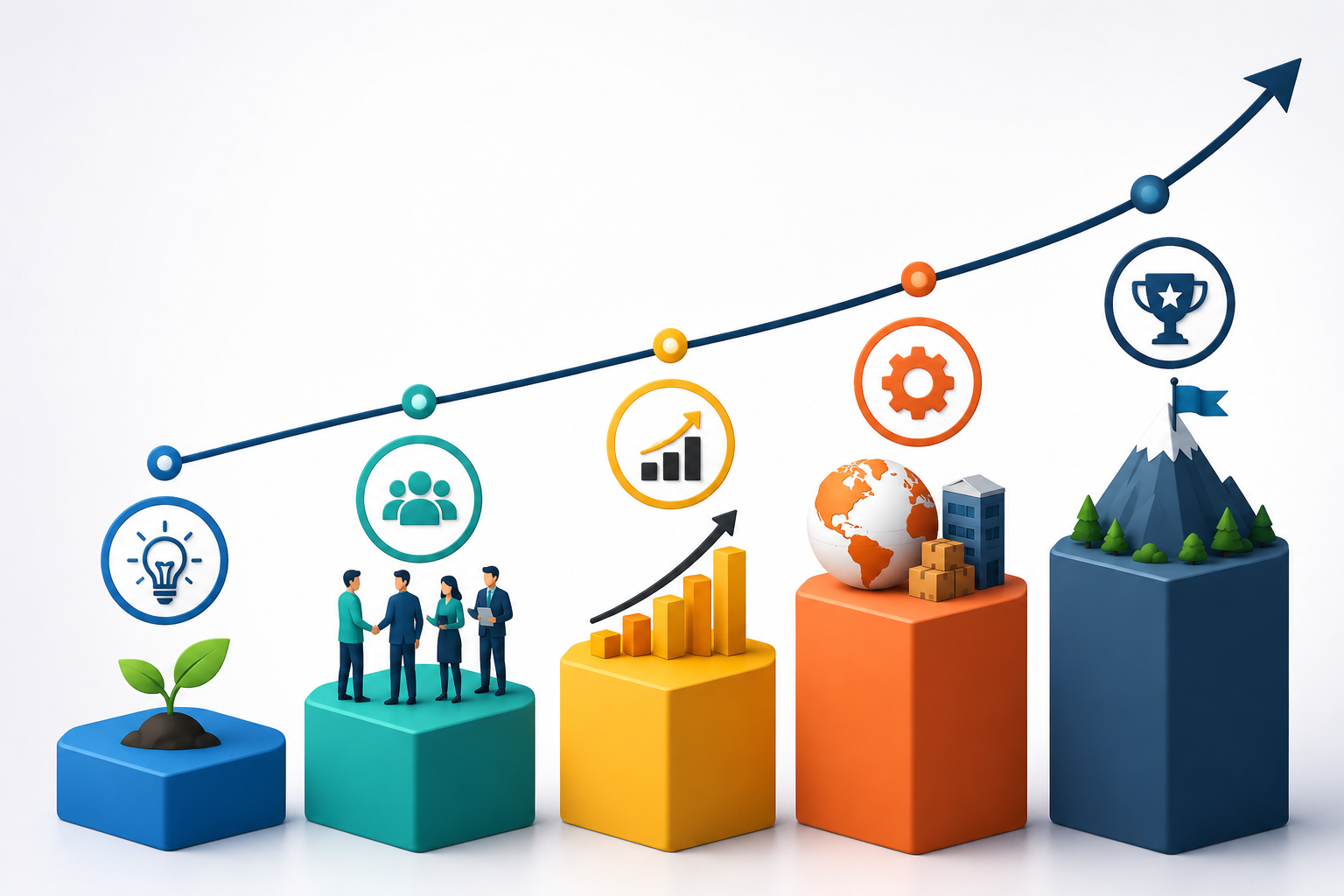
Every successful company starts with an idea, but turning that idea into a thriving, sustainable business requires much more than a great product or service. As businesses grow, their challenges, priorities, and opportunities change. What works during the startup phase may become a barrier to growth later on.
Understanding the different business growth stages helps founders make smarter decisions, avoid common mistakes, and build a company that can succeed for years to come. From validating an idea to managing a mature organization, each phase requires a different approach to leadership, hiring, operations, customer acquisition, and financial planning.
This guide explores the complete business lifecycle and explains how companies can navigate each stage successfully.
Why Understanding Business Growth Stages Matters
Many businesses struggle not because they lack potential, but because they fail to adapt as they grow.
Recognizing your current stage helps you:
- Set realistic goals
- Allocate resources effectively
- Hire the right people
- Build appropriate systems
- Manage cash flow more efficiently
- Prepare for future growth
Growth becomes far more manageable when leaders understand what their business truly needs at each stage.
Stage 1: Idea Validation and Startup
Every business begins with an idea, but not every idea becomes a viable business.
During this stage, the focus should be on validating market demand before investing heavily in growth.
Key Priorities
- Identifying customer problems
- Testing product-market fit
- Conducting market research
- Gathering customer feedback
- Creating a minimum viable product (MVP)
- Securing initial funding
Common Challenges
- Unclear target audience
- Limited financial resources
- Product development issues
- Lack of market validation
- Founder uncertainty
At this stage, flexibility is essential. Successful founders listen carefully to customers and adjust their offerings based on real-world feedback.
Stage 2: Market Entry and Early Growth
Once a product or service gains traction, businesses enter the early growth phase.
Revenue starts to increase, customer acquisition becomes a priority, and founders begin refining their business model.
Key Priorities
- Building brand awareness
- Generating consistent sales
- Developing marketing channels
- Improving customer experience
- Establishing operational processes
Common Challenges
- Inconsistent revenue
- Limited brand recognition
- Resource constraints
- Balancing growth and profitability
Many businesses fail here because they focus solely on growth without creating repeatable systems.
Stage 3: Scaling Operations
Scaling is often the most exciting—and most challenging—phase of business growth.
Demand increases, teams expand, and operational complexity grows rapidly.
Key Priorities
- Hiring skilled employees
- Creating management structures
- Standardizing processes
- Improving productivity
- Expanding customer acquisition channels
- Strengthening financial controls
Common Challenges
Founder Burnout
Many founders attempt to manage every aspect of the business. As the company grows, this becomes unsustainable.
Weak Infrastructure
Processes that worked for a small team often break down under increased demand.
Poor Delegation
Leaders who struggle to delegate can become bottlenecks that slow growth.
Practical Solution
Develop documented systems and empower team members to make decisions. Growth becomes easier when responsibilities are shared effectively.
Stage 4: Expansion and Market Development
Businesses that successfully scale often look for new opportunities to expand.
Expansion may involve:
- Entering new markets
- Launching additional products
- Serving new customer segments
- Expanding geographically
- Forming strategic partnerships
Key Priorities
- Market research
- Risk management
- Customer retention
- Brand consistency
- Operational scalability
Common Challenges
- Expanding too quickly
- Overextending resources
- Losing focus on core customers
- Quality control issues
Sustainable expansion requires careful planning rather than aggressive growth at any cost.
Stage 5: Maturity and Stability
At maturity, the business has established systems, predictable revenue streams, and a strong market position.
Growth may continue, but stability becomes equally important.
Key Priorities
- Operational efficiency
- Innovation
- Customer loyalty
- Talent development
- Long-term planning
Common Challenges
- Market saturation
- Increased competition
- Organizational complacency
- Slower innovation
Companies that remain successful during this stage continue improving rather than relying on past achievements.
Stage 6: Long-Term Sustainability
Long-term sustainability focuses on ensuring the business remains competitive and profitable over time.
This stage requires a balance between stability and innovation.
Key Priorities
- Strategic planning
- Leadership development
- Succession planning
- Financial resilience
- Continuous improvement
- Technology adoption
Organizations that reach this stage often invest heavily in culture, leadership, and adaptability.
How Leadership Changes Throughout Growth
Leadership responsibilities evolve significantly as a company grows.
Startup Phase
Founders often handle everything themselves.
Growth Phase
Leaders begin building teams and managing departments.
Scaling Phase
Delegation becomes critical.
Mature Business Phase
Leadership focuses on strategy, culture, and long-term vision.
The ability to adapt leadership style is one of the strongest predictors of long-term success.
Hiring Strategies for Different Growth Stages
Hiring needs change as businesses expand.
Startup
Focus on versatile team members who can handle multiple responsibilities.
Early Growth
Hire specialists who can strengthen key functions.
Scaling
Build management layers and department leaders.
Mature Business
Develop leadership pipelines and succession plans.
Hiring ahead of growth can strain finances, while hiring too late can limit expansion opportunities.
Financial Management Across Growth Stages
Cash flow management remains critical at every stage.
Early Stages
Focus on survival and maintaining adequate working capital.
Growth Stages
Track profitability alongside revenue growth.
Mature Stages
Prioritize efficiency, forecasting, and long-term investments.
Many businesses experience financial difficulties despite growing sales because they fail to manage cash flow effectively.
Building Systems That Support Sustainable Growth
Strong systems create consistency and reduce dependence on individual employees.
Important systems include:
- Customer relationship management
- Financial reporting
- Sales processes
- Marketing workflows
- Employee onboarding
- Performance tracking
Documented processes help businesses scale without sacrificing quality or efficiency.
Identifying Growth Bottlenecks
Every growing company encounters obstacles.
Common bottlenecks include:
- Limited leadership capacity
- Staffing shortages
- Weak processes
- Cash flow constraints
- Customer acquisition challenges
- Technology limitations
Regular business reviews help identify problems before they become major barriers.
Lessons from Successful Companies
Many successful businesses evolved significantly as they grew.
Early-stage startups often focus on speed and experimentation. Larger organizations prioritize consistency, efficiency, and long-term planning.
One common lesson stands out: successful companies adapt their strategies as circumstances change. They remain customer-focused while continuously improving systems, leadership, and operations.
Frequently Asked Questions
What are the main stages of business growth?
Most businesses progress through startup, early growth, scaling, expansion, maturity, and long-term sustainability stages.
Why do businesses struggle when scaling?
Businesses often struggle due to weak systems, poor delegation, founder burnout, cash flow issues, and rapid growth without proper infrastructure.
When should a business start hiring managers?
Businesses should hire managers when operational complexity increases and founders can no longer effectively oversee every function.
What is the biggest challenge during business expansion?
Expanding too quickly without adequate resources, planning, or operational support is one of the most common expansion challenges.
How can businesses achieve sustainable growth?
Businesses achieve sustainable growth by building strong systems, managing finances carefully, developing leaders, and adapting to changing market conditions.
Conclusion
Business growth is not a single event but a series of stages, each with its own opportunities and challenges. From validating an idea and entering the market to scaling operations, expanding strategically, and achieving long-term sustainability, every phase requires different leadership skills, systems, and priorities. Companies that understand these transitions are better equipped to avoid common mistakes, manage growth effectively, and build lasting success. Sustainable growth comes from balancing ambition with preparation, creating strong foundations, and adapting as the business evolves.