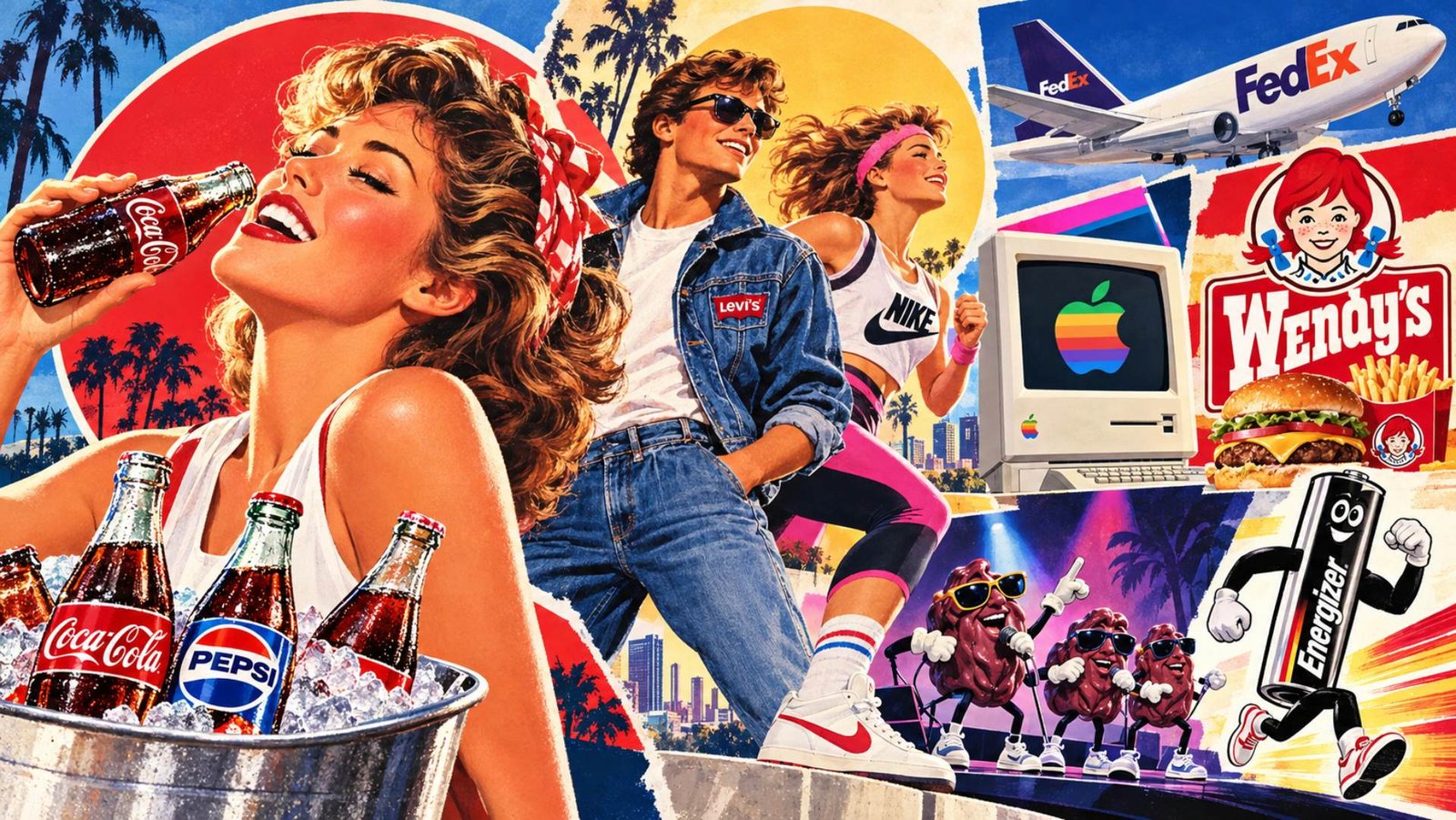
The 1980s produced some of the most memorable advertising ever made. Catchphrases spread into everyday conversation, mascots became pop culture icons, and a single television spot could launch a product into history.
The media landscape has changed completely since then. Marketers now juggle social platforms, search engines, streaming and AI assistants instead of a handful of TV channels and magazines. Yet the principles behind the best ’80s campaigns are remarkably durable.
This article looks at nine 1980s Advertising Campaigns, plus one famous misstep, chosen because each offers a clear, transferable lesson. For each, you will see what the campaign did, why it worked, and how to apply the same thinking to digital marketing today.
Table of Contents
⌄
- Iconic 1980s Ad Campaigns at a Glance
- Big Ideas: Apple and Nike
- Memorable Messages: Wendy’s and FedEx
- Culture and Characters: Pepsi, California Raisins and Energizer
- Style and Systems: Levi’s and Absolut
- A Cautionary Tale: New Coke
- Timeless Lessons for Digital Marketing
- Frequently Asked Questions
- Final Thoughts: Great Ideas Outlast Their Media
Key Takeaways
✓
The strongest 1980s campaigns relied on simple, memorable ideas that audiences could quickly understand and repeat.
✓
Apple, Nike, Wendy’s and FedEx showed how clear positioning, strong slogans and creative demonstrations can make advertising more effective.
✓
Pepsi, the California Raisins and the Energizer Bunny proved the value of culture, personality and recognizable characters.
✓
Levi’s and Absolut demonstrated how visual storytelling and consistent creative systems can build long-term brand recognition.
✓
New Coke showed that customer emotion and brand attachment should be considered alongside data and market research.
Iconic 1980s Ad Campaigns at a Glance
The campaigns below were selected for their cultural impact and for the clarity of the lessons they offer. They are listed in chronological order, not ranked.
| Year | Brand | Campaign | Core Lesson for Today |
|---|---|---|---|
| Early 1980s | Absolut | Bottle-shaped print ads | Build a recognizable creative system you can repeat |
| 1981 | FedEx | The fast-talking businessman | Dramatize your key benefit in a memorable way |
| 1984 | Apple | “1984” | Sell a belief and a moment, not just a product |
| 1984 | Wendy’s | “Where’s the Beef?” | A short, quotable line can travel further than any ad |
| 1984 | Pepsi | “The Choice of a New Generation” | Align with culture and the audience you want to win |
| 1985 | Coca-Cola | New Coke | Never underestimate emotional attachment to a brand |
| 1985 | Levi’s | “Launderette” | Story and music can sell without words |
| 1986 | California Raisins | Claymation singing raisins | Personality can transform a low-interest product |
| 1988 | Nike | “Just Do It” | A simple, flexible brand idea can last for decades |
| 1989 | Energizer | The Energizer Bunny | Humor and a character can own a benefit |
Big Ideas: Apple and Nike
Apple “1984”
What it was: A cinematic commercial directed by Ridley Scott and created with the agency Chiat/Day to introduce the Macintosh. It aired during the Super Bowl in January 1984. A lone runner smashes a giant screen showing a dictator-like figure addressing rows of gray, uniform followers.
Why it worked: The ad barely showed the product. Instead, it positioned Apple as a rebel challenging conformity in computing. It also turned a single broadcast into a cultural event, with news coverage and conversation extending its reach far beyond the original airing.
The lesson from Classic 80s Marketing Campaigns such as Apple’s “1984” is that brands that stand for something can be more memorable than brands that only list features. And the most valuable attention is often earned through conversation, coverage and sharing, not just paid placement.
Nike “Just Do It”
What it was: A tagline and campaign launched in 1988 by Wieden+Kennedy. Early ads featured both famous athletes and everyday people pushing themselves.
Why it worked: “Just Do It” was short, motivational and universal. It spoke to elite athletes and casual joggers alike, and it was flexible enough to work across sports, products and decades.
The lesson today: A strong brand idea should be simple enough to remember and broad enough to stretch across every channel, from a six-second video to a full campaign. Focus on your customer’s ambitions, not just your product.
Memorable Messages: Wendy’s and FedEx
Wendy’s “Where’s the Beef?”
What it was: A 1984 TV ad in which an elderly customer, played by Clara Peller, examines a competitor’s oversized bun with a tiny patty and demands to know where the beef is.
Why it worked: It was funny, short and pointed. The line made a clear comparison with competitors without a long explanation, and it became a national catchphrase, even turning up in political debate that year.
One of the clearest Lessons From 1980s Advertising is that a short, quotable line can become the ancestor of the shareable social post. If people can repeat your message, they will carry it for you. Comparative messaging also works when it highlights a real, easily understood difference.
FedEx’s fast-talking businessman
What it was: A 1981 commercial featuring actor John Moschitta Jr., who talks at an astonishing speed while juggling calls and meetings in a frantic office.
Why it worked: Instead of simply claiming speed, the ad dramatized it. The rapid-fire delivery was entertaining and made the brand’s promise of fast, reliable delivery impossible to miss.
The lesson today: Show your benefit rather than just stating it. In short-form video especially, a vivid demonstration or exaggerated scenario communicates faster and sticks longer than a list of claims.
Culture and Characters: Pepsi, California Raisins and Energizer
Pepsi “The Choice of a New Generation”
What it was: A campaign that positioned Pepsi as the drink of youth and modern culture, famously featuring Michael Jackson in 1984 ads. It built on Pepsi’s ongoing rivalry with Coca-Cola.
Why it worked: Rather than competing on taste alone, Pepsi tied itself to music, celebrity and the energy of a younger audience. It made choosing Pepsi feel like choosing to be part of something current.
Some Retro Advertising Strategies remain relevant because brands still grow by connecting with the culture their audience cares about. Today, that might mean creator partnerships, music, gaming or online communities. The partnership must feel authentic, and it carries reputational risk if the partner and brand values diverge.
The California Raisins
What it was: Launched in 1986 for the California Raisin Advisory Board, the campaign featured claymation raisins singing and dancing to “I Heard It Through the Grapevine.”
Why it worked: Raisins are not an exciting product. Giving them personality, rhythm and humor made them fun, and the characters became popular in their own right, appearing in merchandise and television specials.
The lesson today: Even a low-interest product can earn attention through character and entertainment. If your category feels dull, creativity is your competitive advantage.
The Energizer Bunny
What it was: Introduced in 1989, the drum-beating pink bunny began as a parody of a competitor’s bunny advertising, then marched through fake ads for other products as it kept “going and going.”
Why it worked: The bunny turned an invisible benefit, long battery life, into a visual, humorous running joke. Its interruptions of mock commercials made it surprising and memorable.
The Famous Ads of the 1980s show how a recurring character or format can own a benefit in customers’ minds. Consistent, recognizable creative is valuable in digital marketing, where audiences scroll quickly and repetition builds recognition.
Style and Systems: Levi’s and Absolut
Levi’s “Launderette”
What it was: A 1985 UK commercial by the agency Bartle Bogle Hegarty for Levi’s 501 jeans. A young man walks into a 1950s-style launderette, strips down to his boxer shorts and washes his jeans while other customers watch, all set to “I Heard It Through the Grapevine.”
Why it worked: The ad told a simple, stylish story without a single line of dialogue. It made 501s feel cool and timeless, and it is widely credited with boosting the brand’s popularity in Britain. The soundtrack also returned to the UK charts.
The lesson today: Strong visual storytelling and the right music can communicate a brand’s personality without heavy copy. That matters on social platforms, where many people watch videos with the sound off and judge content in the first few seconds.
Absolut’s bottle ads
What it was: Beginning in the early 1980s, Absolut vodka ran a long-running print campaign built around its distinctive bottle shape, paired with a short two-word headline starting with “Absolut.” The format was adapted for cities, artists, holidays and themes for decades.
Why it worked: The campaign created a consistent, instantly recognizable system while leaving room for endless creative variation. Each new ad felt fresh, yet unmistakably Absolut.
The lesson today: One of the most useful 1980s Marketing Strategies was building recognizable creative systems that could flex across formats and topics. Consistency builds recognition, while variation keeps audiences interested, a balance every content and social media strategy needs.
A Cautionary Tale: New Coke
Not every famous ’80s marketing moment was a success. In April 1985, facing strong competition from Pepsi, Coca-Cola replaced its original formula with a new, sweeter version that had performed well in taste tests.
The public reaction was intensely negative. Loyal customers complained loudly, and within a few months, in July 1985, the company brought back the original formula as Coca-Cola Classic.
What went wrong: The taste tests measured flavor, but they did not capture how emotionally attached people were to the original drink and what it represented to them.
The lesson today: Data is essential, but it can miss emotional context. Before changing a beloved product, design, name or brand element, listen to your community and test reactions to the change itself, not just the new version. Social listening, customer interviews and small pilots can reveal attachment that numbers alone may miss.
Interestingly, the story ended well for the brand: the return of the original showed how much customers cared, making the episode a valuable source of Vintage Advertising Campaign Insights that is still widely studied in marketing.
Timeless Lessons for Digital Marketing
The channels have changed, but the Timeless Marketing Lessons behind these campaigns translate directly to digital marketing.
| 80s Lesson | How to Apply It Today |
|---|---|
| Stand for something | Build a clear brand point of view that shapes content, partnerships and messaging |
| Make it quotable | Write short, distinctive lines people will repeat in comments, posts and searches |
| Show, don’t tell | Use demonstrations, before-and-after visuals and short videos to prove benefits |
| Connect with culture | Partner with creators and communities your audience already trusts |
| Give your brand a character | Develop a consistent voice, mascot or format that people recognize instantly |
| Tell stories visually | Design videos that work without sound and hook viewers in the first seconds |
| Build a creative system | Create flexible templates for social posts, ads and content series |
| Respect emotional attachment | Use social listening and testing before changing beloved products or branding |
One more lesson matters more today than it did in the ’80s: being discoverable. Back then, a handful of TV channels guaranteed attention for big advertisers. Now, people find brands through search engines, social platforms and AI assistants. Even the most creative campaign needs strong SEO, consistent brand information and content that answers real questions, so your brand appears when people look for what you offer.
FAQs
What was the most famous ad of the 1980s?
Apple’s “1984” commercial, which introduced the Macintosh during the Super Bowl, is often cited as one of the most influential ads of the decade and of all time. Wendy’s “Where’s the Beef?” and Nike’s “Just Do It” are also frequently listed among the decade’s most memorable campaigns.
What made 1980s advertising so memorable?
Many ’80s campaigns combined bold creative ideas with catchy slogans, memorable characters and strong music. Limited TV channels also meant large audiences saw the same ads, helping catchphrases spread widely.
When did Nike launch “Just Do It”?
Nike launched the “Just Do It” tagline in 1988, in a campaign created by the agency Wieden+Kennedy.
What can modern marketers learn from ’80s ads?
Key lessons include standing for a clear idea, writing quotable messages, demonstrating benefits visually, building recognizable characters or formats, connecting with culture, and respecting customers’ emotional attachment to a brand.
Why did New Coke fail?
New Coke performed well in taste tests, but customers had a strong emotional attachment to the original formula. The backlash led Coca-Cola to bring back the original as Coca-Cola Classic within months.
Final Thoughts: Great Ideas Outlast Their Media
What Marketers Can Learn From 80s Ads is that great ideas can outlast the media they were originally created for. Apple sold a belief, Wendy’s gave the world a catchphrase, Nike captured an attitude, and the Energizer Bunny turned a battery into a running joke. Even New Coke offers a lesson every brand should remember.
The tools of marketing will keep changing, but people still respond to clear ideas, emotion, humor, character and stories that feel true to the brand behind them.
The biggest difference today is that attention is no longer guaranteed. Customers find brands through search, social media and AI-generated answers. At Megrisoft, we help businesses pair strong creative with SEO, content strategy and AI search optimization, so great ideas reach the people looking for them. If you want your next campaign to be found as well as remembered, get in touch with our team.